

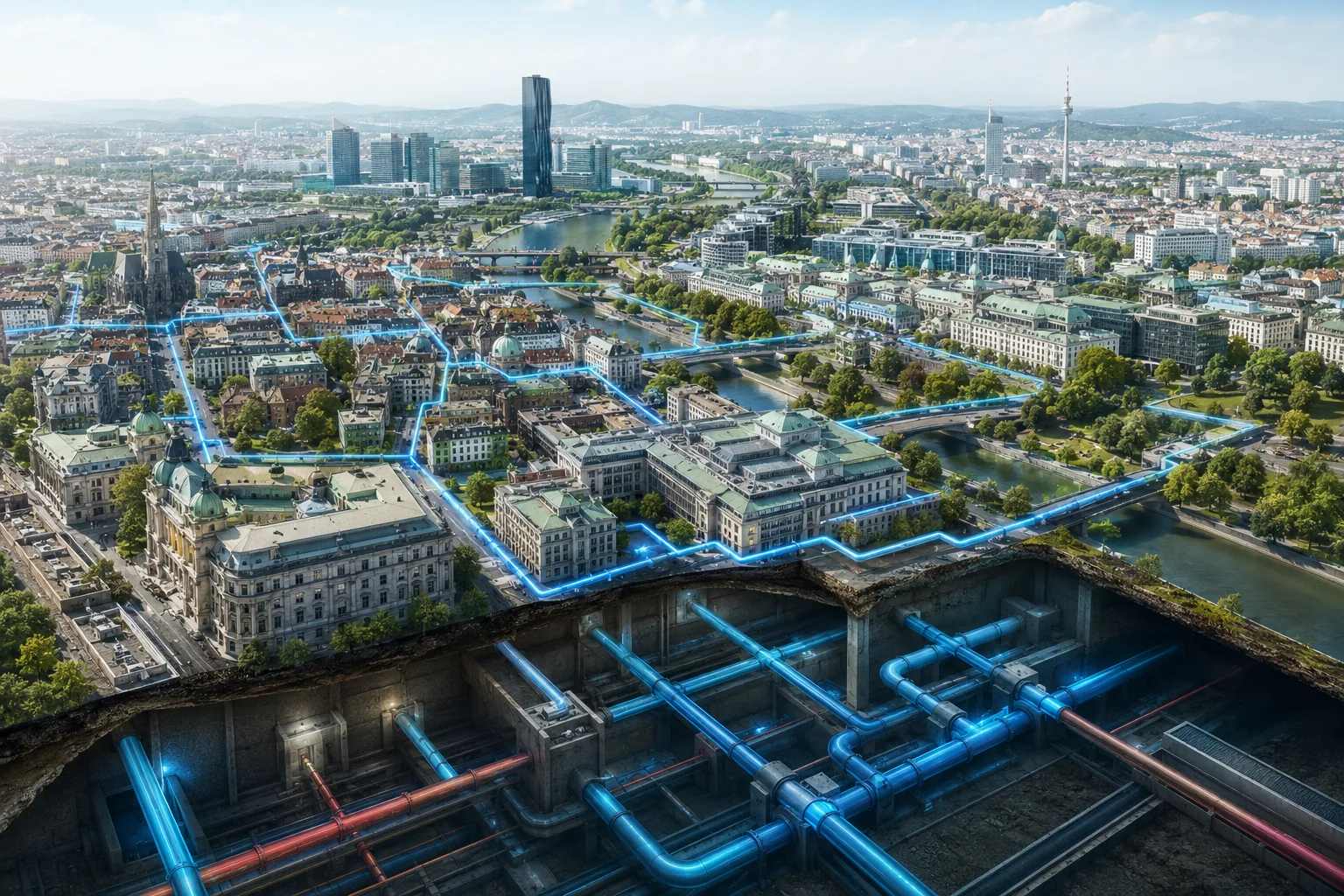
Vienna has been developing its district cooling system for 20 years. The first contract was signed in 2006, and the first plant began operating in 2007 in the Erdberg district. Since then, the network has expanded rapidly, and today Wien Energie operates 25 district cooling sites, supplying cooling to more than 300 buildings.
Connected facilities include, for example:
- 🏥 Vienna General Hospital (AKH)
- City Hall
- University of Vienna
- Natural History Museum
- Ronacher Theatre
- 🏨 Hotel Sacher
- ☕ Café Central
Residential neighborhoods are also being connected to the system. In 2024, construction of a 4.7-kilometer ring network in the city center was completed, and by 2030 Wien Energie plans to invest a further 100 million euros in continued development.
Today, Vienna has the largest district cooling network in Austria. It stretches for about 33 kilometers, which corresponds to roughly three quarters of the entire Austrian network. In 2026, the system’s capacity reached 250 megawatts, and by 2030 it is expected to increase to 370 megawatts.
Rising temperatures are making such systems increasingly in demand. In recent years, Vienna has regularly experienced heat waves and tropical nights. At an air temperature of around 35 °C, demand for district cooling is about 60% higher than at 25 °C. Cooling is becoming not only a matter of comfort, but also an important factor in protecting residents’ health.
How the system works
The operating principle is simple:
- chilled water is produced at dedicated plants;
- it is delivered via underground pipelines to buildings;
- there it absorbs excess heat;
- it returns to be cooled again.
Unlike conventional air conditioners, such a system does not discharge heat directly into the street, which helps reduce urban heat buildup. Additional benefits include:
- noise reduction;
- no outdoor units on building facades;
- the ability to use rooftops for other purposes.
Cooling sources and efficiency
To produce cooling, Wien Energie uses:
- environmentally friendly electricity;
- waste heat;
- natural cooling sources.
In particular, water from the Danube Canal is used, which helps remove heat from the system via heat exchangers. In winter, natural cooling is sometimes sufficient to cover part of the demand.
In summer 2025, an ice storage system was commissioned for the first time on the campus of the Medical University of Vienna. The stored cooling is used during peak-load hours, helping improve the overall efficiency of the entire cooling system.