

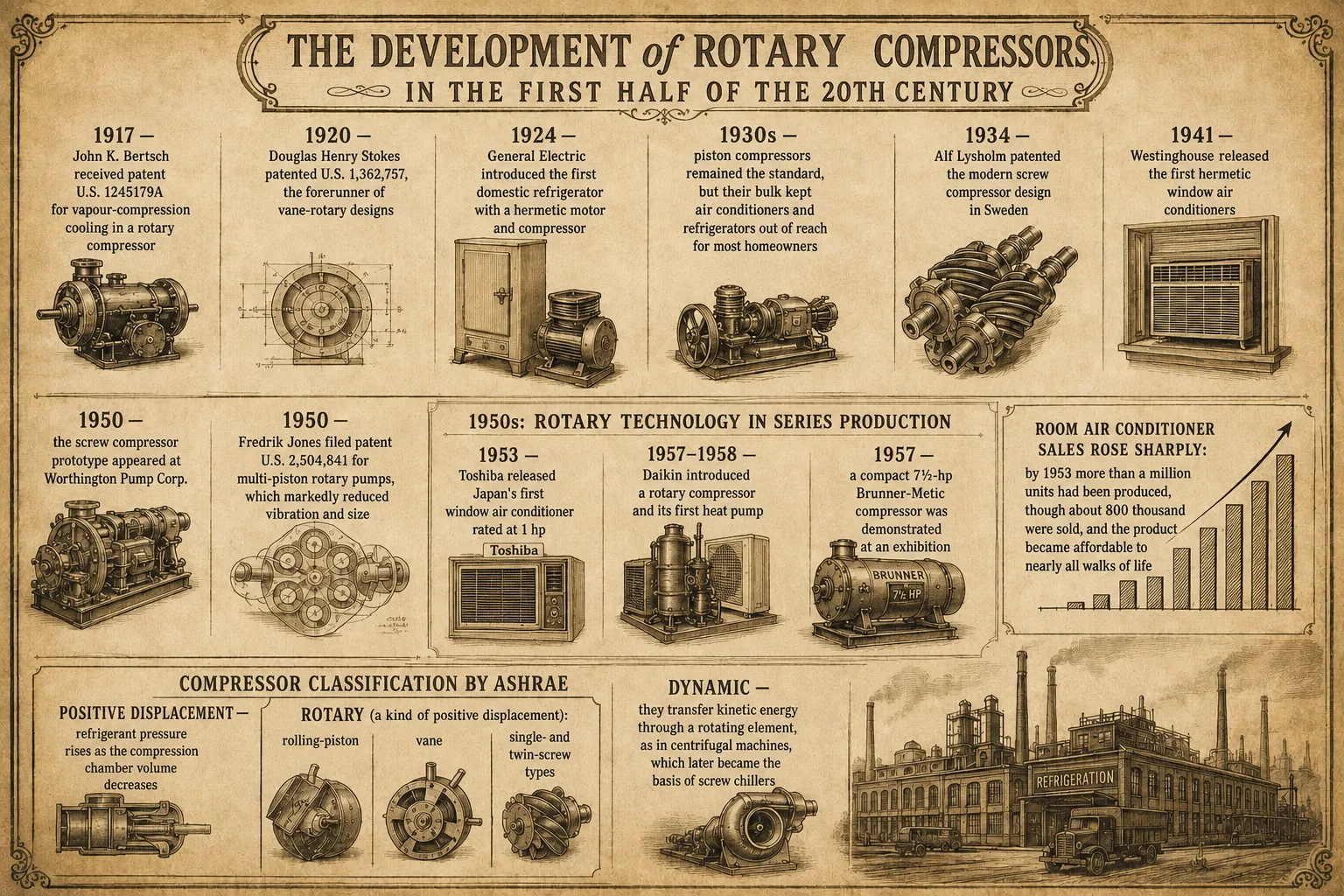
The development of rotary compressors in the first half of the 20th century laid the groundwork for the mass production of compact refrigeration equipment and air conditioners.
As early as 1917, John K. Bertsch received patent U.S. 1245179A for vapor-compression cooling in a rotary compressor.
In 1920, Douglas Henry Stokes patented solution U.S. 1,362,757, which became a predecessor of rotary vane designs.
In 1924, General Electric introduced the first household refrigerator with a hermetic motor and compressor, although early belt-driven models suffered from refrigerant leaks.
By the 1930s, reciprocating compressors remained the standard; however, their bulk made air conditioners and refrigerators unaffordable for most homeowners.
In 1934, Alf Lysholm patented the modern screw compressor design in Sweden.
In 1941, Westinghouse released the first hermetic window air conditioners.
In 1950, a screw-compressor prototype appeared at Worthington Pump Corp., and inventor Fredrick Jones filed patent U.S. 2,504,841 for multi-piston rotary pumps, which made it possible to significantly reduce vibration and the overall size of the equipment.
In the 1950s, rotary technology entered mass production, changing system marketing and design.
In 1953, Toshiba released Japan’s first window air conditioner with a capacity of 1 hp.
Daikin in 1957–1958 introduced a rotary compressor and the first heat pump.
That same year, a compact 7½-hp Brunner-Metic compressor was demonstrated at an exhibition.
📈 Sales of room air conditioners rose sharply: in 1953, more than 1 million such units were produced, although about 800,000 were sold, and the products became affordable to virtually all segments of the population.