

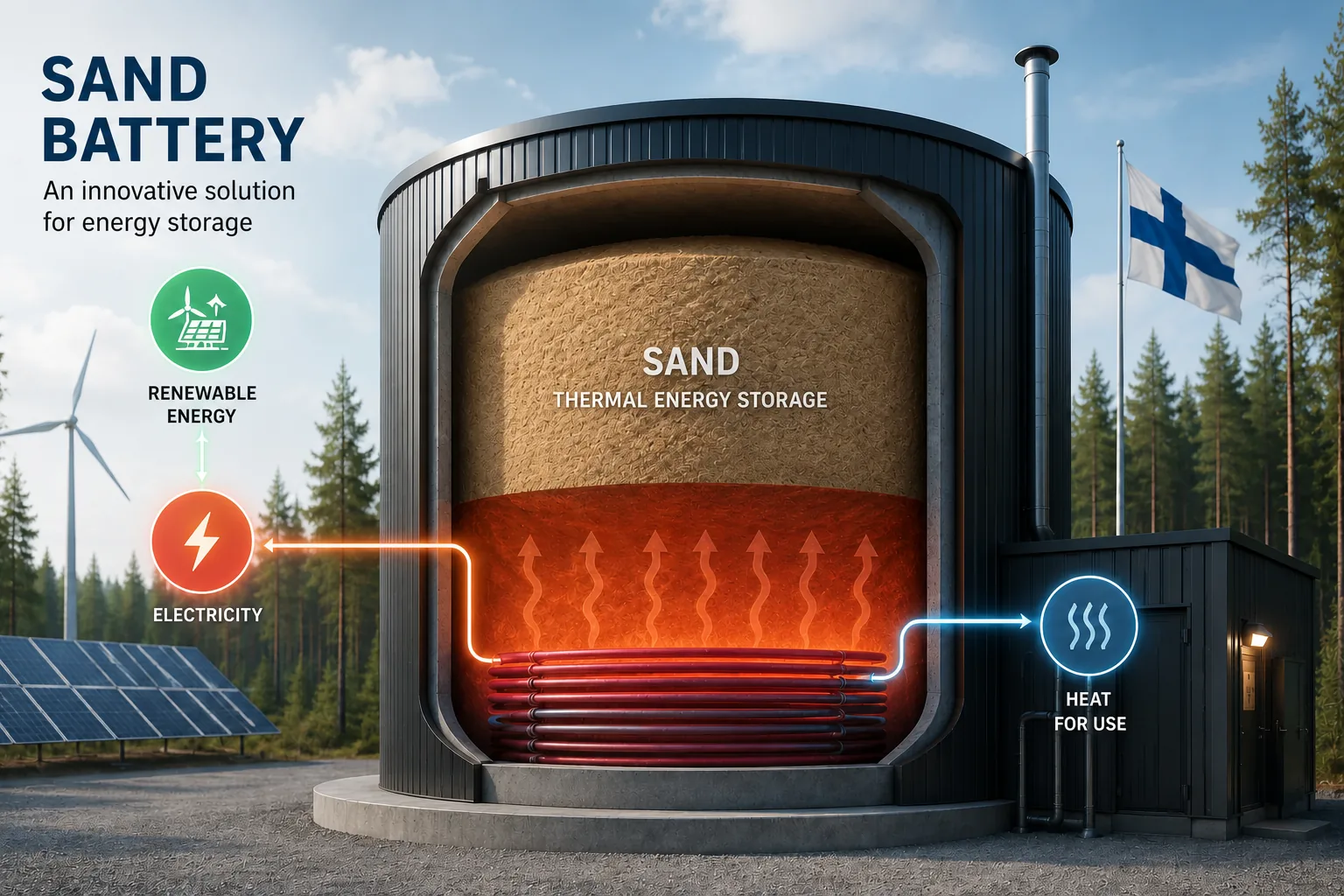
Scientists from Aalto University in Finland have developed a prototype of an unusual energy storage system in which ordinary quartz sand is used instead of traditional lithium-ion batteries. This system belongs to “Carnot batteries”, where electricity is converted into heat and the stored heat is then used again to generate energy. In the new setup, sand serves as the thermal storage medium: it is heated by electric heating elements inside a thermally insulated tank, after which the heat drives a Stirling engine that converts the temperature difference into electricity.
For the experiment, the researchers assembled a setup with a power rating of about 1 kW. Inside a 0.2 cubic meter tank was quartz sand with grain sizes from 0.6 to 2 millimeters. A commercial Microgen Stirling engine was used as the energy converter, and standard sauna heating elements were used for heating. During tests, the sand was heated to 300–350 °C, after which it gradually released heat to the engine, allowing the system to generate electricity:
- about 9 hours at 300 °C
- up to 14 hours at 350 °C with a peak power of 690 W
However, the overall efficiency of the system remains relatively low for now. In the experiments, only 4.4–8.3% of the input energy could be converted back into electricity, whereas modern lithium-ion batteries typically return more than 90% of the stored energy. The reason was not so much the sand itself as heat losses through the system walls and the engine cooling system. For example, in one of the cycles the system received 53 kWh of electricity, but delivered only 2.33 kWh back; another about 16.5 kWh went to engine cooling, and more than 34 kWh was simply dissipated into the environment.
The low thermal conductivity of sand created additional difficulties, because heat spread through it slowly and the engine periodically experienced a shortage of heat flow. To address this problem, the scientists propose adding metal elements or special thermally conductive structures to the sand. At the same time, the very concept of a “Carnot sand battery” proved workable, and sand turned out to be a convenient material for heat storage:
- it is inexpensive,
- widely available,
- non-toxic,
- able to withstand temperatures above 1700 °C without breaking down,
which promises a significantly longer service life for such systems compared with chemical batteries.