

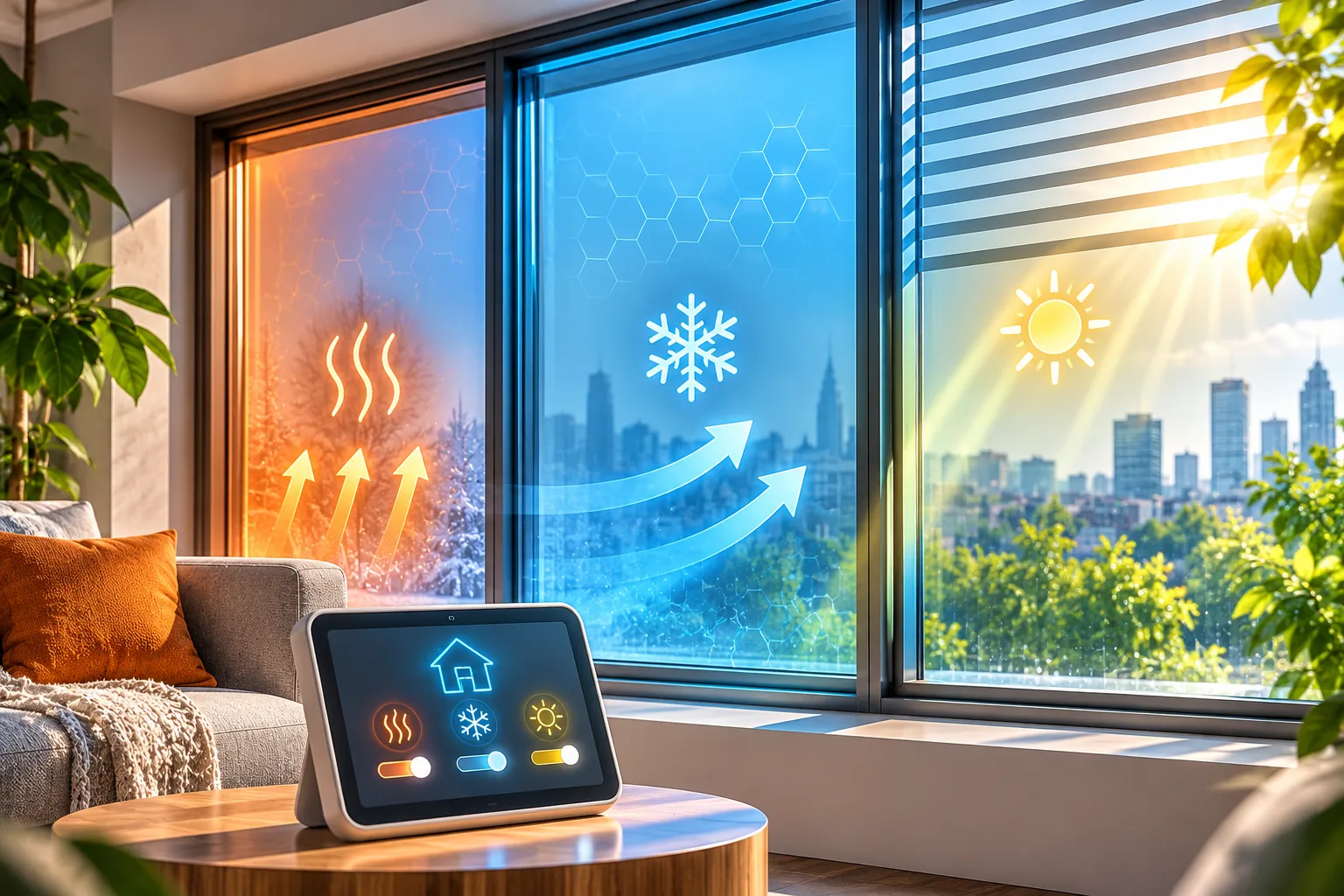
In a scientific review published on November 16, 2026 in the journal Communications Materials (publisher Springer Nature), the evolution of smart window technologies is examined—from simple solar light regulation to multifunctional thermoregulation systems. The study analyzes the potential to combine the following functions within a single insulated glazing unit:
- 🔥 heating
- ❄️ cooling
- 💧 condensation prevention
- 🌤️ light transmittance control
The role of windows as a key element of building energy efficiency is emphasized.
Traditional glass surfaces, while providing natural daylight, lead to:
- excess solar heat in summer
- significant heat losses in winter
- fogging and icing that reduce comfort
Seoul National University researchers Yongju Jung and Seung Hwan Ko in their paper “Thermal-regulating smart windows for a sustainable future” assess how active and passive technologies enable windows to adapt to seasonal changes by managing infrared radiation without compromising visible light.
Active solutions, such as Joule heating or dielectric heating using transparent conductive coatings based on indium tin oxide and silver, demonstrate high efficiency: at light transmittance of about 87%, they remove ice in 50 seconds.
Passive low-emissivity coatings, including hydrogen-doped indium oxide with 84% transmittance and low emissivity in the infrared range, make it possible to:
- save up to 6.6% of heating energy in cold climates
- ensure durability under exposure to ultraviolet light and moisture
Special attention is given to thermoelectric modules based on the Peltier effect, integrated into window systems for localized cooling without conventional refrigerants. In experiments, eight such modules reduced the indoor temperature by an average of 2 °C with power consumption of 45 W, although the effective cooling capacity was about 35 W, indicating the need to optimize heat rejection.
The researchers conclude that promising solutions combine multiple functions in a single design, improving overall energy efficiency without increasing operating costs.