

How it all started: our Air Conditioner Rating
We have already covered how to decode GMCC compressor markings — how to read displacement, power supply type, and series straight from the model code. But reality turned out to be more complicated: to compare two compressors fairly by capacity, decoding the model code alone is not enough. We got into this not out of academic curiosity, but for a very practical reason. In our Air Conditioner Rating there is a parameter that compares compressor capacity with the rated capacity of the air conditioner itself. This is an important indicator: it reflects how well the split system is actually backed by “hardware” for its nameplate numbers. This parameter gives the air conditioner noticeable points in the overall score.
And this is where something interesting happened. The CT-65A09 air conditioner initially ranked lower than the Rovex Grace RS-09MST1. The numbers did not match what we knew about the models, so we dug in. The root cause was exactly this — compressor capacity is stated under different test systems. Below is what we found out.
When you open the GMCC catalog, it is easy to run into an oddity: the same compressor is listed with different cooling capacities. For example, a unit with a displacement of 9.8 cm³ is stated as 2780 W in one column and as 2395 W in another. The difference is 16%, almost half a kilowatt. There is no mistake here. It is all about the test conditions under which the capacity was measured.
A compressor’s cooling capacity is not a constant “built into” the hardware. It is the result of a test-bench measurement at strictly specified temperatures. Change the temperatures — and the number changes. In GMCC catalogs you will see three main designations: GX, ASH, and ARI.
What GX, ASH, and ARI conditions mean
Parameter GX ASH ARI Evaporating temperature 7.2 °C 7.2 °C 7.2 °C Condensing temperature 46.0 °C 54.4 °C 54.4 °C Suction gas temperature 35.0 °C 35.0 °C 18.3 °C Ambient temperature 35.0 °C 35.0 °C 35.0 °C
GX — conditions per the updated Chinese standard (GB). The “mildest”: low condensing temperature of 46 °C. It is easier for the compressor to push refrigerant → cooling capacity and COP figures come out at their maximum.
ASH — ASHRAE conditions with hot suction. High condensing at 54.4 °C and hot gas at the inlet (35 °C) — the harshest mode. The numbers here are the most modest, but closer to real summer operation.
ARI — the US standard (AHRI 540). The same high condensing at 54.4 °C, but the suction gas is cold (18.3 °C). Cold vapor is denser, more refrigerant mass flows through the compressor — so ARI yields results higher than ASH, but lower than GX.
In simple terms, why the numbers differ
Compressor performance primarily depends on what pressure it is working against. The lower the condensing temperature, the lower the discharge pressure and the compression ratio — the compressor has an easier job, it pumps more refrigerant and delivers more cooling with less energy input. Under GX, condensing is 46 °C; under ASH, it is 54.4 °C. Those eight degrees are what produce that +16%.
Bottom line on condition “severity”: for the same unit GX > ARI > ASH. Therefore, when comparing two compressors in a catalog, always check whether the figures are from the same column. Comparing GX for one to ASH for another is like measuring one person’s height with shoes on and the other barefoot.
⚠️ Do not confuse this with T1. Sometimes you will see T1 nearby (per ISO 5151 / GOST): outdoor +35 °C, indoor +27 °C. But these are conditions for testing the entire air conditioner, not an individual compressor. For compressors, the relevant ones are GX / ASH / ARI.
A clear example from the GMCC catalog
Let’s take compressors of the same size — displacement 9.8 cm³:
Model Conditions Cooling capacity COP ASM99V1VFZ GX 2780 W 4.28 ASM99V2UDZ ASH 2395 W 3.04
Essentially the same unit, but under different measurement modes: the difference in cooling capacity is 385 W (16%), and the “on-paper” COP differs by 1.5×. That is why it is so important to compare compressors under identical conditions.
Practical comparison example: ASM95 vs KSM89
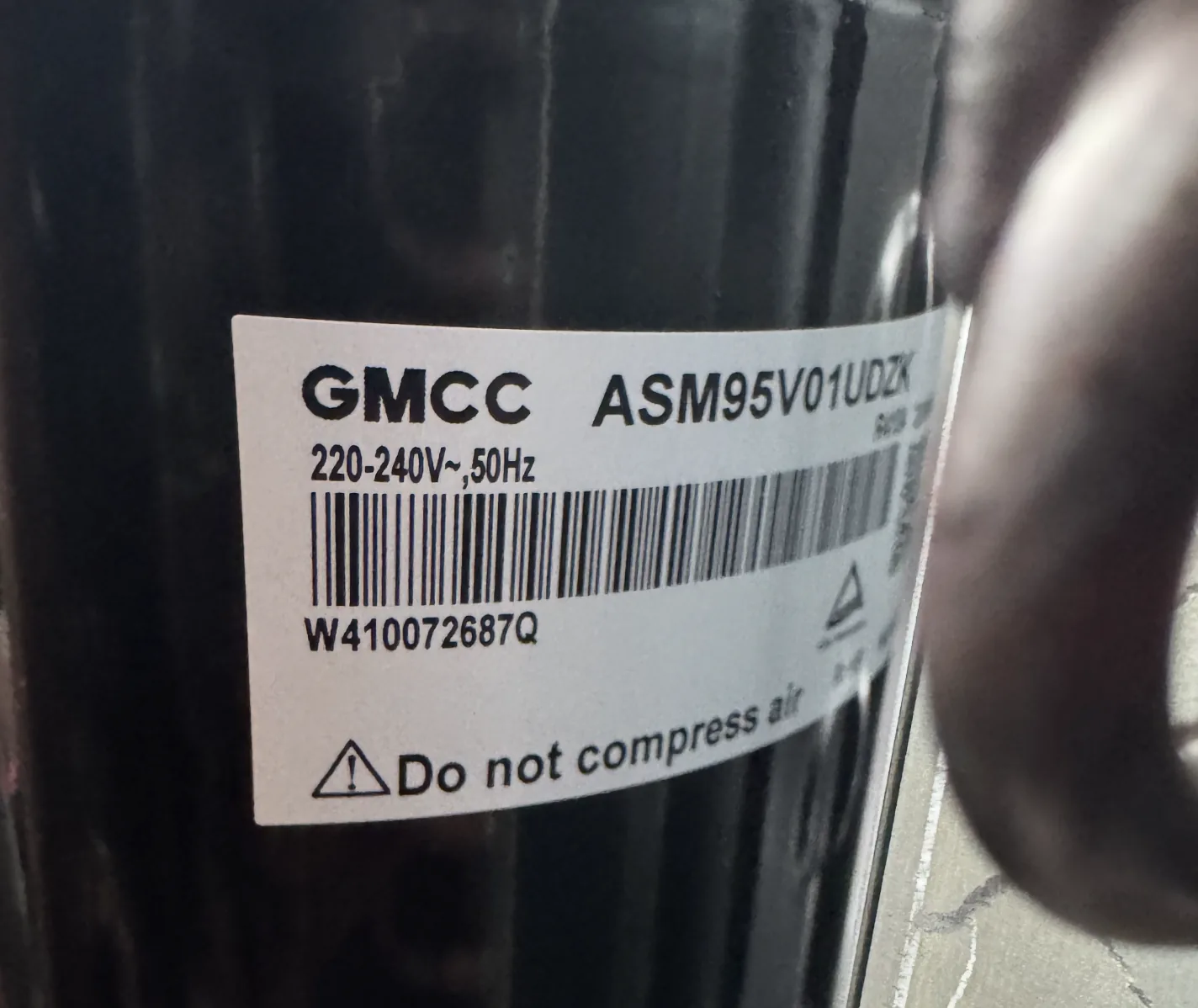
Suppose you need to understand which compressor is more powerful — GMCC ASM95V01UDZK (R410A, 9.5 cm³) or GMCC KSM89V13UDZK (R32, 8.9 cm³).
Immediate trap: ASM95 in the catalog is measured under ASH, while KSM89 is under ARI. You cannot compare their numbers directly. Bring them to the same conditions — take the R32 analog of ASM95 with the same displacement (KSM95V13UDZK), measured under the same ARI conditions as KSM89:
            ARI CONDITIONS, R32 (the same for both)
┌─────────────────────┬─────────┬───────────┬──────────┐
│ Model               │ Volume  │ Cooling, W│ Input    │
├─────────────────────┼─────────┼───────────┼──────────┤
│ KSM89V13UDZK        │ 8.9 cm³ │   2195    │  ~770 W  │
│ KSM95 (= ASM95)     │ 9.5 cm³ │   2365    │  ~830 W  │
└─────────────────────┴─────────┴───────────┴──────────┘
   Difference: +170 W of cooling in favor of the 9.5 cm³ (≈ +8%)
Conclusion: ASM95 is more powerful — it simply has a larger displacement (9.5 vs 8.9 cm³). More displacement per revolution = more refrigerant pumped = more cooling under any identical conditions. The gap is small (~8%), the units are in the same class, but the 9.5 cm³ one is consistently stronger.
What about other manufacturers? The GREE / LANDA example
Other compressor manufacturers use the same test conditions too — they just label them differently. A good example is the GREE catalog (compressor division Zhuhai Landa, LANDA brand, 2024). In every model table they have a “test conditions / 测试工况” column, and there are two variants:
Fixed-speed compressors (R410A and R32) are measured under ASHRAE/T — these are the same conditions GMCC labels as ASH (high condensing, hot suction). A harsh, realistic mode.
Inverter compressors (R32/R410A) are measured under New national standard (新国标) — the new Chinese national standard (GB). Essentially the same as what GMCC hides behind the GX abbreviation (“mild” conditions with low condensing).
So the same physical mode is called differently by different brands: ASH ≈ ASHRAE/T, and GX ≈ New national standard (GB). A summary table of who writes what in their catalog:
Manufacturer / compressor type Designation in catalog Meaning of conditions GMCC — R410A, fixed-speed GX and ASH (two columns) mild + harsh at once GMCC — R32 ARI medium GMCC — inverter SEER60 seasonal efficiency GREE/LANDA — fixed-speed (R410A/R32) ASHRAE/T = ASH (harsh) GREE/LANDA — inverter (R32/R410A) New national standard (新国标) = GX / GB (mild)
Practical takeaway. If you compare a GREE fixed-speed compressor (measured under ASHRAE/T — harsh conditions) with a GMCC number under GX (mild conditions), you are comparing apples to oranges, and GREE will look weaker than it really is. Always bring both models to the same mode. The good news: ASHRAE/T at GREE and ASH at GMCC are the same thing, so fixed-speed models of these two brands can be compared directly.
How it ended: Centek beat Rovex
Let’s return to where we started. In our rating, the Centek CT-65A09 air conditioner (GMCC compressor ASM95V01UDZK) initially ranked lower than the Rovex Grace RS-09MST1 (GMCC compressor KSM89V2, 2195 W). And when we dug into it, the reason turned out to be exactly what this whole article is about.
The compressor capacities were taken under different methodologies: for Centek — under the “harsh” ASH (lower number), for Rovex — under the “mild” GX, which always shows a higher result. No surprise that Rovex pulled ahead on this parameter — it was simply measured on a more favorable scale. A classic case of comparing the incomparable.
As soon as we brought both compressors to one methodology, everything fell into place. The Centek compressor is larger (9.5 cm³ vs 8.9 cm³) and in an honest comparison delivers more cooling. Centek deservedly beat Rovex in the rating. That is how one mixed-up methodology almost distorted the final score — and that is exactly why we now verify test conditions so meticulously.
To make it clearer, we put the compressors we encountered in these air conditioners into one table — with capacity under both methodologies at once:
Compressor Displacement Refrigerant Type GX, W ASH, W QINGAN YZG-A089FY8T9 8.9 cm³ R32 inverter ~2515 — GMCC KSK75D33U 7.5 cm³ R32 inverter ~2325 — GMCC KSN86V22 8.6 cm³ R32 fixed-speed 2550 ~2200 GMCC KSM89V2 (Rovex) 8.9 cm³ R32 fixed-speed ~2650 ~2280 GMCC ASM95V01UDZK (Centek) 9.5 cm³ R410A fixed-speed ~2650 ~2300 GMCC KSM99V01 9.9 cm³ R32 fixed-speed ~3040 ~2600 GMCC ASM103V01 10.3 cm³ R410A fixed-speed 2900 ~2500 GMCC KSM135V02UEZE 13.3 cm³ R32 fixed-speed 4085 ~3500
A dash in the ASH column is for inverter compressors: they run at variable frequency, they do not have a single “harsh” point (they are measured under their own methods — GB/SEER). ASH values marked with “~” are calculated (converted from GX using a verified factor ≈ 0.86); direct catalog values are listed in the GX column without “~”.
Why this matters when choosing an air conditioner
This whole CT-65A09 vs Rovex Grace story is a clear example that behind a nice capacity number on the box there are many nuances an ordinary buyer simply does not see. Two air conditioners with the same declared capacity can be built around compressors whose characteristics were measured under different standards — and the real difference between them will not be what the price tag suggests.
That is exactly why in our Air Conditioner Rating we do not take marketing numbers at face value. We go into compressor catalogs, bring characteristics to the same conditions, and assess how well the equipment actually matches what is claimed. When you choose an air conditioner by our rating, you are choosing not by a pretty picture, but by honestly aligned numbers backed by this kind of work. Take a look at the rating before buying — it will save you both money and nerves.
Sources and notes
ARI figures (condensing 54.4 / liquid 46.1 / evaporating 7.2 / suction 18.3 / ambient 35.0 °C) and all model data (ASM99, KSM89, KSM95) — from the GMCC Rotary Compressor 2021 catalog (pp. 13, 28, 39).
GX and ASH temperatures — per industry standards (ASHRAE / Chinese GB). The GMCC catalog itself does not provide a temperature table for the GX/ASH columns — only the designations are given. The GX condensing figure of 46 °C is confirmed indirectly: in the catalog, GX mode always yields higher cooling capacity than ASH, which corresponds to a lower condensing temperature.
GREE/LANDA data (ASHRAE/T designation for fixed-speed and New national standard / 新国标 for inverter) — from the Zhuhai Landa Compressor catalog (LANDA brand, GREE) “Compressor for RAC&CAC”, 2024, sections Residential fixed speed and Residential inverter.