

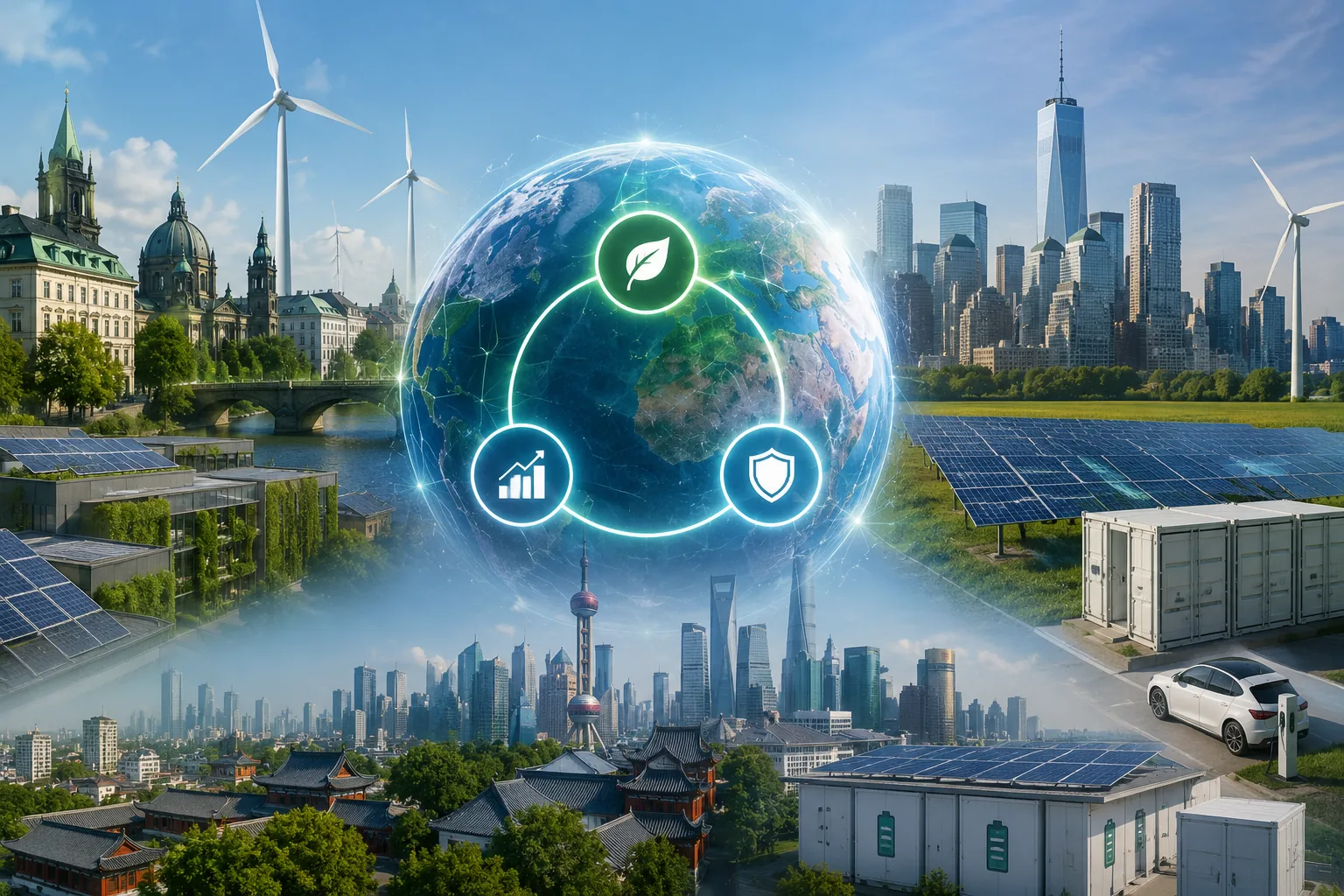
The integration of renewable energy sources is actively transforming industry, enabling companies to:
- reduce operating costs 💰
- increase energy independence
- accelerate the transition to decarbonization 🌱
According to the International Energy Agency, renewables already generate about 30% of global electricity, yet IRENA believes it is necessary to triple installed capacity by 2030. In 2024, a record 582 GW of new capacity was added, but the pace still falls short of COP28 goals. ABB projects in different countries demonstrate how technical and economic barriers can be overcome.
In Finland, on the site of a former peat extraction area, EPV Energy built one of the largest solar power plants, Heinineva, with 123,000 panels, which at peak will supply electricity equivalent to the consumption of 20,000 electric vehicles.
Key elements of the project:
- an automation system coordinates inverter operation
- provides remote monitoring via SCADA
- enables participation in the reserve capacity market
- a new substation with protection and distribution integrates the facility into the grid
In the United States, a 3-acre photovoltaic plant was installed at a 47-year-old factory in South Carolina, generating 1.5 million kWh per year and covering up to 80% of the facility’s demand, delivering annual savings of about $70,000.
In Germany, at the Gundelsheim site, nine compact secondary switchgear units:
- reduced equipment volume by 50–75%
- provided a 15% economic advantage when connecting to the medium-voltage grid
At the Spanish school Colegio Virgen al Pie de la Cruz, a similar system paid back in 4.5 years, combining reduced energy consumption with educational objectives.
In China, at an altitude of 4,400 m in the Yalong River valley, the Chabulang plant with a capacity of 1,000 MW was built, featuring:
- sealed equipment
- modular architecture
- remote control adapted to low pressure, intense ultraviolet radiation, and temperature swings
The facility will produce 1.944 billion kWh annually, replacing 600,000 tonnes of coal and cutting CO₂ emissions by 1.55 million tonnes. These examples show that digitalization and sound engineering turn renewable energy into a tool for improving the efficiency, reliability, and profitability of industrial facilities.