

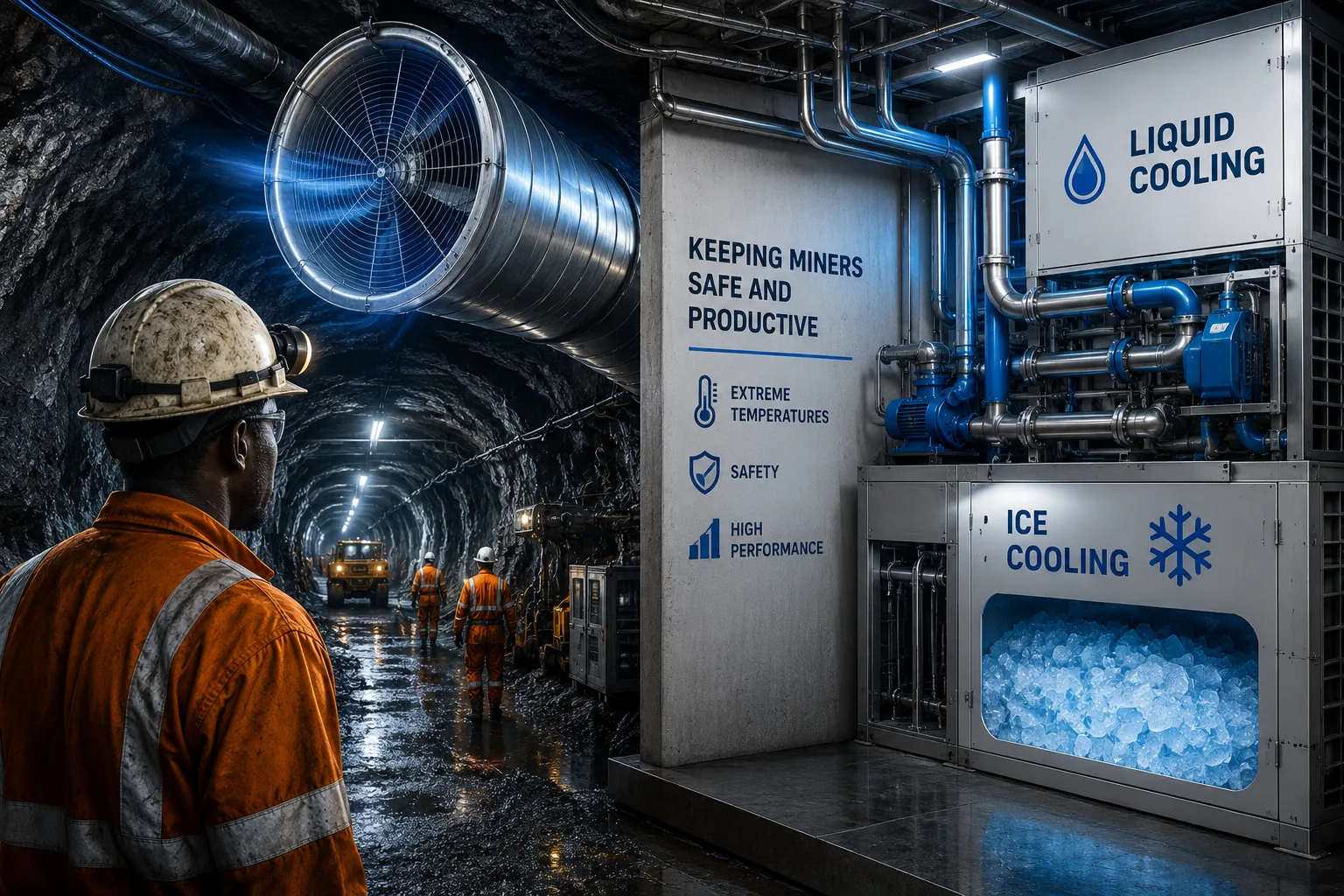
At the Howden Technology Day conference, James Howden Holdings applications engineer Matthew Slabbert spoke about the evolution of mine cooling systems that help cope with extreme conditions at great depths. As mining goes deeper, rock temperature and heat release from equipment rise sharply, creating not only discomfort but also a real safety threat. Without effective cooling, productivity drops and risks to personnel increase many times over.
At the core of any scheme is the task of creating a safe and workable environment. Systems can supply:
- cooled air,
- chilled water,
- or a combination of both.
The choice of strategy depends on:
- the depth of the workings,
- the magnitude of heat loads,
- distances,
- the availability of free space,
- the cost of electricity.
Most mines start with conventional ventilation, supplying fresh air from the surface. The simplest enhancement to this scheme is bulk air cooling at the surface before it is sent down the shaft. This approach is relatively simple and cost-effective, but it can lower the air temperature only by about five degrees, and at a depth of around two kilometers its effectiveness drops sharply.
To extend cooling to greater depths, mines switch to chilled-water systems. Water can carry heat over long distances with minimal losses, and at a flow rate of about one hundred kilograms per second, one such system can remove up to nine megawatts of heat load. Nevertheless, the cost of an extensive pipeline network often exceeds the cost of the refrigeration equipment itself, so the economically justified use of such systems is limited to depths of about 2.5–3 kilometers.
As depth increases further, conventional ventilation and water cooling methods can no longer cope:
- heat loads increase,
- routes become longer,
- energy consumption rises sharply.
Under these conditions, fundamentally different solutions are required, and the next stage in the development of mine cooling systems becomes ice-based technologies.