

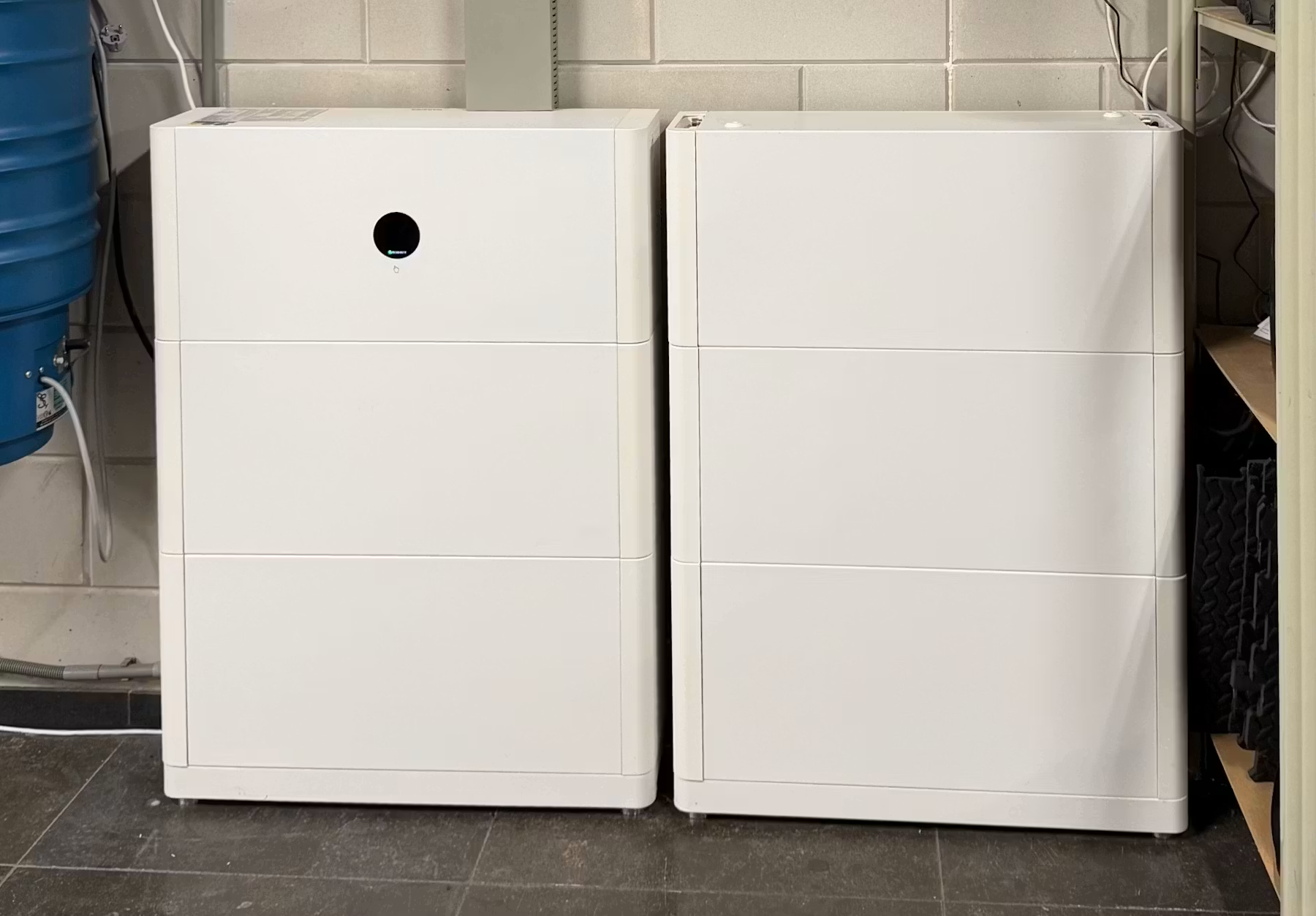
Home batteries, also known as home energy storage systems, are widely available today. Suppliers are benefiting from the end of the net-metering scheme. The aim is to make storing your own solar energy profitable. And suppliers claim you can make money with them. But how exactly does that work? Consultant Wim Schermer ran the numbers and answers eleven questions.
1. When is it useful to have a home battery?
According to Schermer, a home battery only makes sense if there are solar panels on the roof. “The number of solar panels should match energy consumption; that means from six to twelve panels. Home batteries are only a worthwhile investment if they can be charged and discharged at least 250 times a year. A battery that charges from solar panels in summer but is not fully used in the evening, at night and the following morning is too large. Technically, that’s of course possible, but unused capacity is a waste of money.” According to Schermer, this can mean that thousands of euros were invested for nothing. Just as home batteries that are not fully discharged in the evening are useless, he believes the same applies to home batteries that are not fully charged during the day. “In that case, part of the capacity is also not used, and the battery ends up unnecessarily large and expensive.” With a minimum of 250 charge and discharge cycles, a home battery is used at least 80 percent. In that case, the payback period is at most eight years, which Schermer considers acceptable. “If the utilization level drops to 40 percent, the payback period approaches sixteen years. Sixteen years corresponds to the service life of a home battery; with such a payback period you therefore don’t earn anything. In that case, for example, it’s better to put the money in the bank.” However, a battery can be genuinely useful in homes with a large number of solar panels. Schermer: “Many people covered their roofs with solar panels because of the net-metering scheme, but after the abolition of that scheme they no longer get anything for feeding electricity into the grid.” According to Schermer, a home battery can somewhat offset these losses, but even then, if the battery is not discharged in the morning, its capacity is too large.
2. How do you determine the capacity of a home battery?
According to Schermer, to determine the right capacity of a home battery you need to multiply the annual electricity consumption by 0.7. This means electricity consumption in the evening, at night and the following morning. The result must be divided by 365, the number of days in a year. With an electricity consumption of 3000 kWh, this yields a home battery with a capacity of 5.8 kWh. According to Schermer, this battery will be charged and discharged at least 250 times a year. “For a battery with a capacity of 5 kWh you will need six to eight solar panels, from which you will get energy from March to November.”
3. Is it worth installing a home battery with dynamic electricity tariffs?
According to Schermer, a home battery is not sensible without solar panels, but would it be profitable if you use dynamic electricity prices? In Schermer’s view, it is not. “It delivers too little energy; you might have only one euro a day left. That leads to an excessively long payback period.”
4. However, some suppliers claim that you can make money with home batteries. Is that true?
Suppliers who claim this are not telling the truth. Energy trading by charging at low tariffs and feeding back at high tariffs will be a thing of the past after 1 January 2027. “You still get 6 cents per kWh for feed-in, but energy suppliers also charge 6 cents for feeding electricity into the grid. So nothing remains.” During consultations, Schermer recently encountered deception by one supplier. “A company called Domogo offered a woman a home battery with a capacity of 25 kWh, claiming that over twenty years she could earn 43 700 euros from it. The cost was 13 100 euros, so in the end she would make a profit of 30 600 euros. The woman’s electricity consumption was 2150 kWh per year, the solar panels produced 4000 kWh per year, and she still heated the home with gas. In such a situation a home battery is practically useless, let alone a 25-kilowatt one. This is therefore outright fraud, especially considering that the woman had to take out a loan to purchase the battery.”
5. Does it make sense to use a home battery for an electric car and a heat pump?
According to Schermer, a home battery does not make sense for charging a car. “With a home battery with a capacity of 5 kWh you won’t get far by charging a car with a battery capacity of 60 to 80 kWh. The same applies to a large and expensive home battery with a capacity of 10 kWh or more.” In Schermer’s view, a home battery is also useless for a heat pump. “Typical consumption for a heat pump is 2 kW. If you run it on a home battery with a capacity of 5 kWh, it will be discharged in just 2.5 hours. A heat pump can run for 5 hours on a battery with a capacity of 10 kWh, but an investment of 6000–9000 euros results in an excessively long payback period.”
6. Can a home battery be a solution if time-of-use electricity tariffs are introduced in 2029?
No, even when time-of-use electricity tariffs come into effect in 2029, a home battery will not solve the problem for heat pumps, Schermer believes. In the current proposal, the high-tariff period in the winter months starts at 16:00 and ends at 23:00; that is seven hours, and that is exactly when many people are at home. “During those seven hours a heat pump consumes up to 14 kWh. But even a battery of that size is useless. After all, solar panels produce hardly any electricity in the winter months, so you still won’t be able to compensate for those seven hours with a home battery.” And charging during the day when electricity prices are low? Schermer: “That will deliver too little energy to provide a good payback period for a home battery.” To compensate for those seven hours, Schermer sees more advantages in using a hot water storage tank. An article on this topic will follow soon.
7. What types of home batteries are on the market?
According to Schermer, those who want to buy a home battery have roughly two options: a compact plug-in battery or a larger permanently connected home battery. “The first category includes plug-in batteries such as the HomeWizard Plug-In Battery with a capacity of 2.7 kWh. It is easy to install, but has limited capacity and lower practical efficiency.” HomeWizard states an average efficiency of 70 to 85 percent; in practice this means that 2.7 kWh of storage yields about 1.9 to 2.3 kWh of usable energy. “Capacity can be expanded with multiple modules. However, the electrical connection must be carefully considered. One battery provides a maximum of 800 W. Using several batteries can increase charging capacity, but for greater discharge capacity a separate circuit will be required.” The second option is a larger, permanently connected home battery, often combined with a hybrid or separate inverter. Such systems generally have higher capacity and power and may be suitable for three-phase connection. They are more efficient than many plug-in batteries, but not without losses: energy is also lost during charging, discharging and backfeed. Depending on the brand and system, the battery can be connected, for example, to Home Assistant via Modbus, an API or an energy management system. This makes it possible to control the battery intelligently—for example, charge it when electricity prices are low or when sufficient solar energy is available, and discharge during periods when electricity is more expensive.
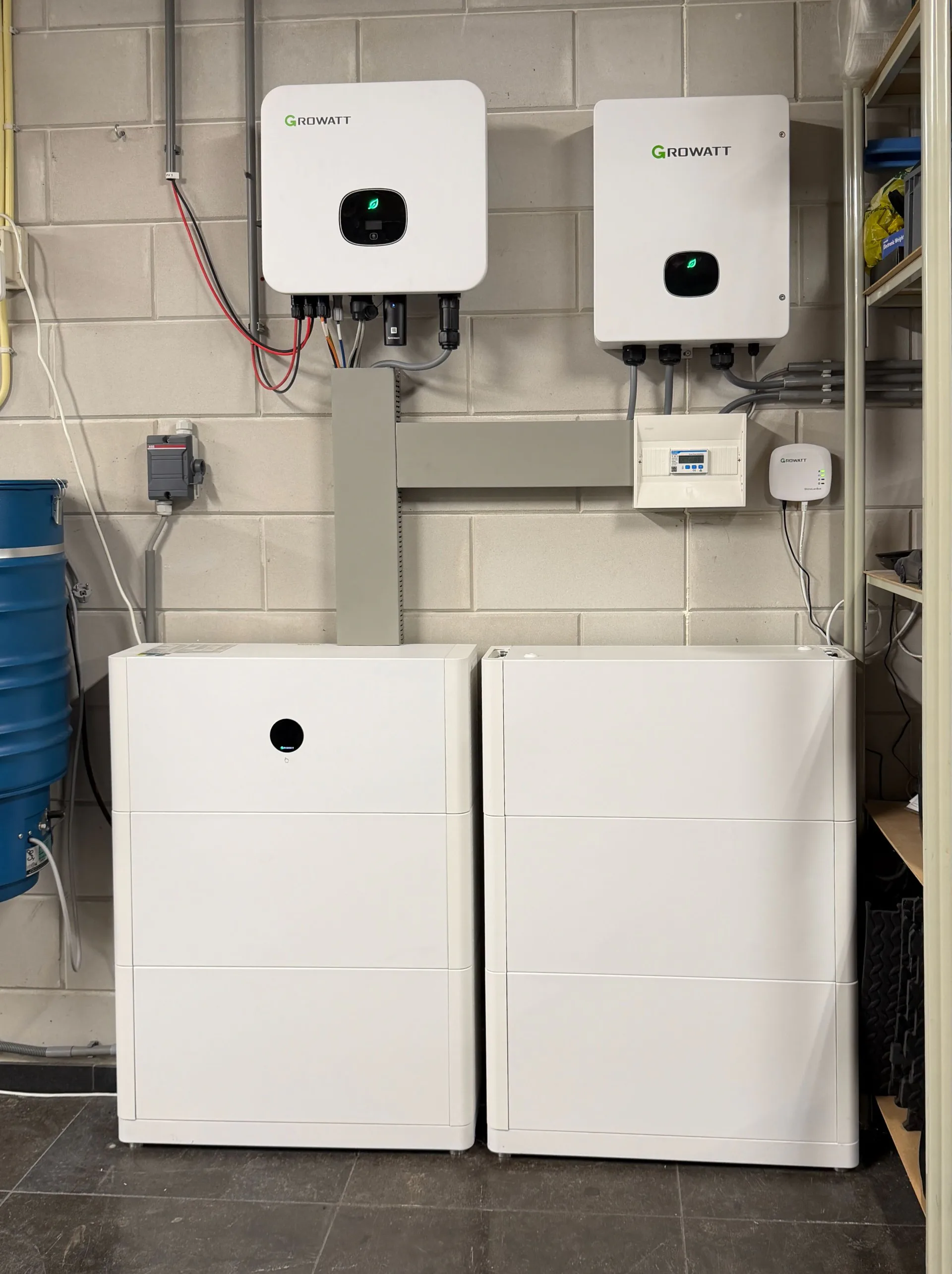
Home battery in Wim Schermer’s home. He installed it as an experiment as part of his consulting work for a business park. It is a large 25.6 kWh battery; above it are a hybrid inverter and an emergency power module.
8. Will home batteries become cheaper?
The current price of home batteries is about 450 euros per kWh. But that price is falling. For example, there are already suppliers of large batteries at 300 euros per kWh. A battery only becomes truly attractive at a price of 200 euros per kWh. In that case, you can buy a battery without penalties and always recoup your investment. For that, the current price of a home battery is still too high, and it only pays back at 250 charge and discharge cycles per year.
9. How long does a home battery last?
The standard operating life is 6000 cycles; with 250 charge and discharge cycles that comes to 24 years. There are home batteries capable of withstanding even more cycles. However, that is only theory. For example, in severe cold or heat, the service life is reduced.
10. Does a home battery affect grid congestion?
Yes, the impact can be two-sided: a home battery can relieve the power grid, but at certain times it can actually create additional load. This depends mainly on how the battery is controlled. If home batteries respond to dynamic electricity prices, a new peak moment may arise. If the electricity price drops sharply, many batteries may start charging simultaneously. For individual households this makes sense, but at neighborhood level it can mean a sudden increase in electricity demand. Especially in areas where many homes have solar panels, heat pumps and home batteries, this can create additional strain on the local power grid. A home battery can also help smooth peaks. During the day, solar energy can be temporarily stored rather than fed directly into the grid. In the early evening, when many households use electricity at the same time, the battery can supply the home with electricity. As a result, less electricity is needed from the grid at that moment. Thus, the impact of home batteries on grid congestion largely depends on how they are deployed. If batteries are used mainly to use one’s own solar energy more efficiently and to limit neighborhood peak loads, they can help reduce the load on the energy grid. If, on the other hand, they are deployed mainly to respond to low market prices or sharp price fluctuations, they can actually increase the load on the energy grid.
11. What about safety?
“Modern lithium iron phosphate (LFP) batteries are very safe. However, this is on the condition that the installation of larger, stationary systems in particular is carried out by a qualified specialist. Assembling a cheap Chinese kit yourself using cables that are too thin and cheap connection materials can pose a significant fire risk. In the event of a fire, the insurer may use ‘culpable’ actions as grounds to refuse compensation or substantially limit it. Checking with your insurer will quickly clarify this.”